
In 1958 an American essayist, Leonard Read, set out to write the biography of an ordinary pencil and reached a conclusion that still unsettles admirers of the lone genius: there is not a single person in the world who can make one from start to finish. It takes someone to fell the cedar, someone to mine the graphite, someone to smelt the brass and someone to mix the eraser, and then someone to ship it and sell it, while hardly any of them know each other or suspect they are working together on a pencil. If an object worth a few cents demands such a concert of wills, it is fair to ask on what grounds we keep telling success as a solo feat.
Aristotle had summed it up long before: whoever can live without others is either a beast or a god, and twenty-four centuries have not produced many specimens of the latter. Spanish keeps the same lesson in a word we use without looking at it: «compañero», companion, comes from the late Latin companio, the one who shares bread. Perhaps that is why the most reliable thermometer of a team is the corner bakery. Two mornings are enough to tell whether the people behind the counter like each other, put up with each other or count the minutes, and you end up buying your bread there, or not, accordingly.
Every company is a team with a brand name
The same goes for the local hairdresser as for a multinational. Behind every brand there is a handful of people, or a few thousand, and its success depends directly on the quality of that group and on how they talk to each other. Anyone with children at school can tell within a few weeks the one where teachers, administration and management communicate from the one where everybody defends their office like a trench. The building and the syllabus may be identical; what families experience is nothing alike.
The brands we admire know it. At the 2019 Brazilian Grand Prix, Red Bull's mechanics changed all four tires on Max Verstappen's car in 1.82 seconds, then a world record; none of them, working alone, would have got under several minutes. Google spent two years studying 180 of its own teams, in a project it named, with a certain Hellenic flair, Aristotle, and what mattered most turned out to be something very homely: that every member could make a mistake in front of the others without having it held against them. And a Coca-Cola reaches any village bar thanks to local teams that never appear in an ad. What these companies cultivate is what we call at camp, without further ceremony, good vibes.
What money can't buy
Dan Ariely, the economist who has devoted his career to showing that we are predictably irrational, paid volunteers to build Lego figures. Some had each finished figure kept; others watched theirs being taken apart in front of them while they started the next one. The pay was the same and, even so, the second group gave up much sooner. Nobody enjoys their work if they feel that what they do matters to no one.
Ariely also tells how a group of lawyers refused to help a retirees' association for around thirty dollars an hour, while many agreed to do it for free. We move between market norms, where everything is calculated, and social norms, where things are done for others, and the second kind breaks as soon as everything has a price. That is where a team's good atmosphere lives: it can be looked after or spoiled, but it cannot be ordered from a supplier.
A country of small teams
In Spain, according to the Ministry of Industry, SMEs make up 99.8% of companies. Almost all of us work, or will work, in small teams, often family ones, where there is no department to ask for a transfer to when the colleague at the next desk is difficult. We know this first-hand, because we have been a family business since 1985: in a group like that every person weighs more, for better and for worse, and you need to know how to behave and adapt to people who will not always welcome you with open arms, as they do at home.
Teamwork is trained, like swimming
Nobody learns to swim by reading a manual. You get to teamwork by sharing out tasks, sometimes unfairly; by settling conflicts between people who want different things and are both partly right; and by sitting down to think, with some self-criticism, about what works and what does not. Some teams make it easy, others almost impossible and the odd one impossible altogether. You come out of all three knowing something, even if from the last one it is only how to spot it in time.
There is also a matter of the calendar: nobody can do it all, if only because people fall ill, go on vacation or have to take their mother to the doctor. There always needs to be a second person for the days you are not there. And often someone is holding us up without our knowing, just as we hold others up without realizing, as in the invisible web behind the pencil.
New faces
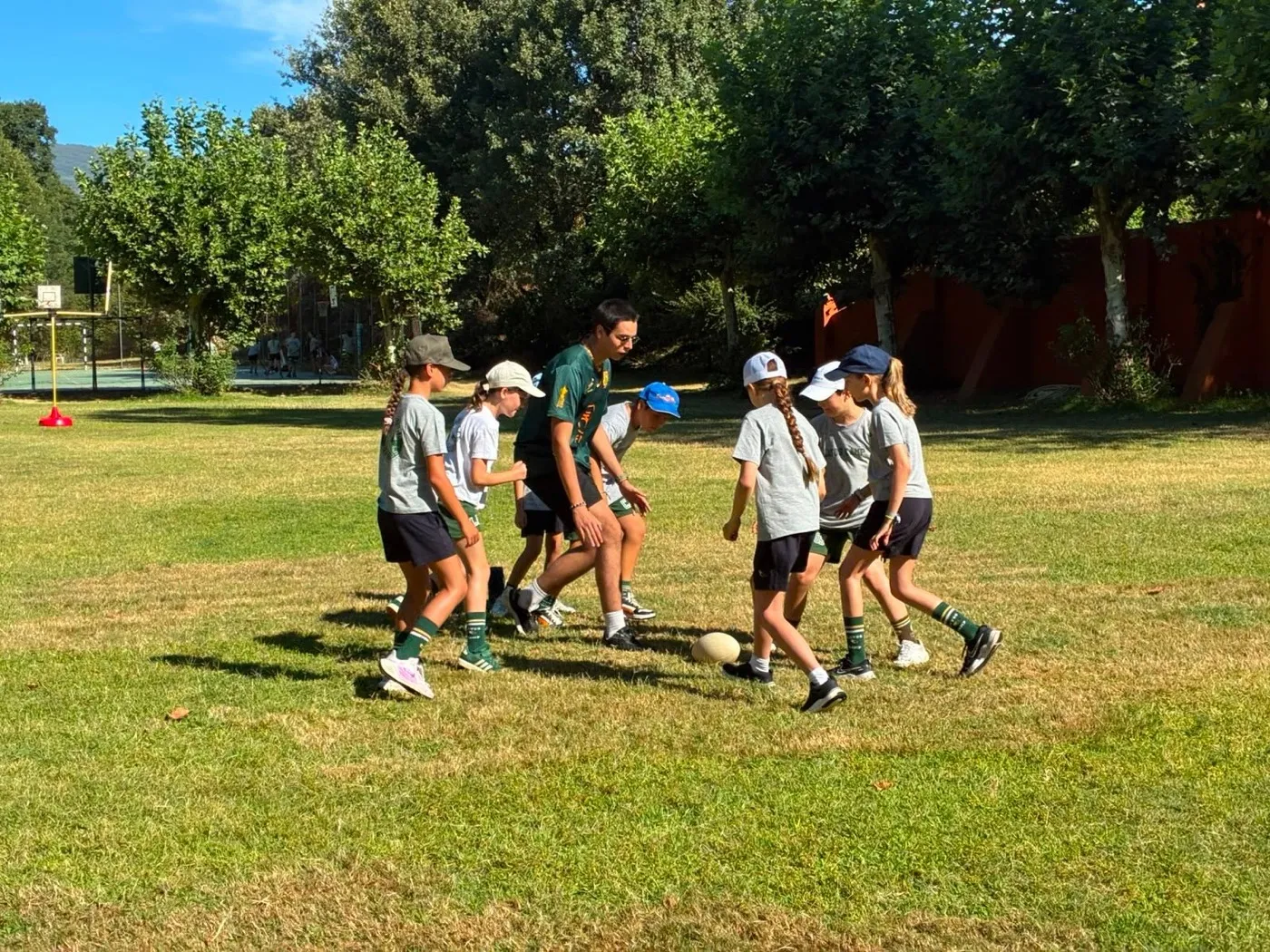
All of this starts long before adult life. When children leave home they meet new faces, and the more they see, the sharper their social sense becomes. They learn to tell the nervous friend from the calm one, the better-mannered from the one who is not quite there yet, and they pick up the different vibes of each camper, each counselor and each coordinator. Nobody teaches them: they practice, get it wrong, try again and grow up almost without noticing.
Ariely and his colleagues called it the IKEA effect: our tendency to value more what we have built with our own hands. Friendships work in a similar way: those built by living together, waiting your turn or putting up with a roommate who snores last longer than the ones you find ready-made. A camp like the one in Toledo or in Gredos is, seen this way, a crash course in a grammar no school subject teaches and that every company, from the multinational to the bakery downstairs, will end up asking for.
Read insisted that nobody knows how to make a pencil and yet millions of people have had a hand in every one. Teams are the same, and it is worth children finding out early: nobody succeeds alone, there will always be someone behind you, and learning to be with others is the surest way to get somewhere. If you want to see where our campers practice it, here are all our camps.
Sources
- Leonard E. Read, “I, Pencil” (1958), Foundation for Economic Education: fee.org
- Aristotle, Politics, Book I
- Real Academia Española, Diccionario de la lengua española, “compaña”: dle.rae.es
- Formula 1, Red Bull’s record stop at the 2019 Brazilian Grand Prix, 1.82 seconds: formula1.com
- Google re:Work, “Understand team effectiveness” (Project Aristotle): rework.withgoogle.com
- Ariely, Kamenica and Prelec, “Man’s search for meaning: The case of Legos”, Journal of Economic Behavior & Organization (2008): doi.org
- Dan Ariely, Predictably Irrational (2008)
- Spanish Ministry of Industry and Tourism, press release of 27 November 2025: mintur.gob.es
- Norton, Mochon and Ariely, “The IKEA effect: When labor leads to love”, Journal of Consumer Psychology (2012): dash.harvard.edu